 Why energy matters more than time
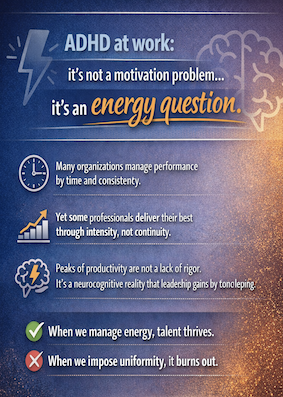
In many organizations, performance is still assessed through time: hours spent at the office, availability, and workload. This approach feels reassuring because it’s easy to measure—but it overlooks an essential factor: the quality of human energy. People living with attention deficit disorder with or without hyperactivity (ADHD) illustrate this particularly well. They often must mobilize more brain resources to start a task, sustain attention, and regulate emotions, which can translate into productivity peaks followed by periods of deep fatigue.
Research on glucose metabolism shows that the brain consumes about 20% of the body’s energy while representing only about 2% of its mass. Studies using PET imaging have also reported lower cerebral glucose metabolism in adults diagnosed with ADHD in key regions involved in attention and executive control (including higher/superior prefrontal regions). This imbalance contributes to the sense of “neurocognitive exhaustion” described by many adults with ADHD.
A particular neurocognitive dynamic.
Imaging work suggests that reduced metabolic activity in prefrontal areas can impose a higher “energy cost” to perform tasks that look routine from the outside. At the same time, all of us make countless decisions every day. Popular sources sometimes estimate this number in the tens of thousands; however, the exact figure varies widely by definition and measurement. What is better supported is the underlying concept: repeated decision-making can be associated with decision fatigue—a state where the quality of self-regulation and subsequent decisions can deteriorate, especially under sustained cognitive strain.
For people with ADHD, this dynamic can become close to constant, even when decisions aren’t particularly complex, because much of the day involves sustained executive control (staying on task, filtering distractions, shifting attention, inhibiting impulses). Work that requires persistent executive functioning is also associated with higher burnout risk among employees with ADHD, with executive function deficits proposed as a mediator. [8] The invisible effort required to maintain attention, manage interactions, and “mask” difficulties often leads to exhaustion and a higher risk of burnout.
Why measure energy rather than time?
Time-based culture no longer reflects reality. Productivity per hour does not necessarily increase with more hours worked, and cognitive fatigue shows up when we’re asked to stay focused for too long. Two people can complete the same task with very different energy expenditure—and that expenditure can vary for the same person from one day to the next.
By focusing on mental, emotional, and physical energy, organizations can understand employees better and offer more appropriate accommodations: flexible hours, recovery periods, results-focused culture rather than presence-focused culture, and so on. Workplace flexibility and tailored adjustments are frequently highlighted as practical levers for neurodivergent inclusion (e.g., adapting schedules, reducing sensory distractions, enabling recovery). Recognizing energy variability also means not projecting one’s own rhythm onto others.
Fatigue and exhaustion: a vicious cycle
In adults with ADHD, brain hyperactivity can filter distractions less effectively and impose continuous vigilance. Every interaction or unexpected change may feel intense, and the accumulation of micro-decisions amplifies executive fatigue.
Guilt about feeling exhausted adds another layer of stress. Some people develop sophisticated strategies to appear “like everyone else” (ultra-structured environments, constant reminders, choosing careers aligned with their strengths). These strategies can work for a time, but they have a cost: anxiety, depression, and energy collapse when a major event occurs or when workload suddenly increases. ADHD masking/camouflaging is discussed in both clinical and lived-experience literature as potentially burdensome and exhausting over time.
Organizing work around energy
Managing energy doesn’t mean reducing workload—it means organizing it differently. A first step is to observe personal rhythms: identify high- and low-energy periods and plan accordingly. Complex tasks (analysis, writing, strategic thinking) can be scheduled during energy peaks, while lower cognitive-load activities (filing, proofreading, emails) can be reserved for lower-energy moments.
This approach often increases productivity while reducing exhaustion. Organizational support can include valuing results, encouraging calm environments, allowing regular breaks, and enabling schedule adjustments.
Strategies to recharge energy
- Active recovery: Research summarized by Cornell Health notes that purposeful breaks (roughly 5–60 minutes) can increase energy, productivity, and ability to focus when they genuinely refresh the mind and body. Evidence syntheses on micro-breaks similarly report benefits for well-being and, in many contexts, performance. Real breaks are walking, breathing, creativity—not endless scrolling.
- Movement and exercise: Physical activity can influence catecholamines involved in attention and arousal regulation (including norepinephrine), and exercise is widely studied as a supportive nonpharmacological strategy for ADHD symptoms and executive functioning.
- Nutrition and sleep: A diet rich in fruits, vegetables, complex carbohydrates, and protein can support more stable energy and satiety, and some clinical resources discuss these patterns for supporting attention and energy regulation. Adults are commonly recommended to sleep 7–9 hours per night; guidance from the National Heart, Lung, and Blood Institute aligns with this range. Avoiding screens close to bedtime is also a common sleep-hygiene recommendation, and research links pre-bed screen use to poorer sleep outcomes.
- Mindfulness and cardiac coherence: Mindfulness-based interventions (including MBSR/MBCT-type approaches) have been studied in ADHD, with meta-analytic evidence suggesting improvements in ADHD symptoms and related outcomes compared with waitlists, though results vary by design and comparator.
- Support and coaching: Specialized ADHD coaching can help identify fatigue triggers and implement tailored strategies. Empirical evaluations in academic contexts report improved outcomes and provide preliminary support for effectiveness, while also calling for further randomized designs.
Valuing ADHD strengths
Talking about energy and fatigue should not erase the strengths associated with ADHD. Research on creativity in adults with ADHD shows nuanced patterns but supports meaningful links between ADHD traits and aspects of creative thinking/achievement in some contexts.
Research on ADHD and entrepreneurship reports associations between ADHD symptoms and entrepreneurial profiles/orientation, with recent meta-analytic work synthesizing dozens of studies.
The ability to intensely immerse in an activity that is motivating (hyperfocus) can lead to high productivity and quality of work. A recent study reported frequent hyperfocus in many adult ADHD participants and noted productivity benefits for a subset, particularly in flexible or creative roles.
Greater cognitive flexibility can also support perspective-taking and rapid adaptation, and ADHD-related impulsivity can sometimes translate into risk tolerance and resilience when supported by good self-management and context fit.
Conclusion
For professionals with ADHD, performance is not simply a matter of hours spent at the office. Their brains may expend more energy to complete tasks like their colleagues’, which can show up as peaks of performance and phases of fatigue. Neuroimaging studies have reported differences in cerebral glucose metabolism in adults with ADHD, supporting the plausibility of variable “energy cost” for executive control.
By adopting a results-focused and flexible culture, companies improve inclusion and overall performance. Valuing ADHD strengths and offering energy-sensitive accommodations helps build a more human, more inclusive, and more effective work environment for everyone.
Invitation
Do you recognize yourself in this description, or would you like to understand your energy rhythms better? I offer personalized support to help you observe your cycles, adopt effective strategies, and turn your strengths into professional assets. I invite you to contact me so we can take stock together. Together, we can learn to manage your energy better and optimize your performance—without exhausting yourself.

