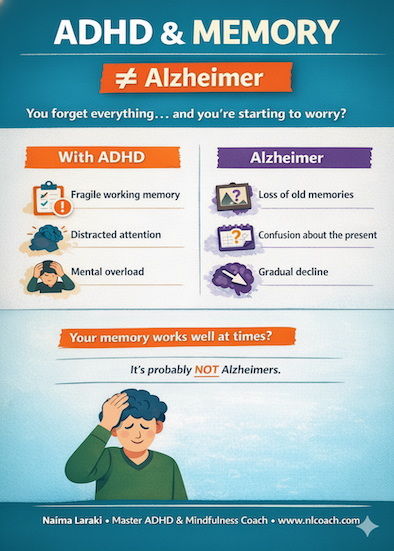
 Why you forget… and why it’s probably NOT your memory!
Many high-performing adults living with ADHD experience this baffling moment: You forget an appointment. You lose an object that was in your hand just moments ago. Someone just explained something to you… and the information seems to vanish. Very often, a worrying thought appears: “Is my memory deteriorating?” Some people even go as far as fearing a serious neurological problem. Yet, in most cases for adults living with ADHD, long-term memory works very well. The challenge lies elsewhere.
The Most Frequent Misunderstanding
Frequent forgetfulness gives the impression of a memory problem. However, neuroscience research shows that in people living with ADHD, long-term memory is generally intact. The challenge primarily concerns two systems:
- Working memory
- Attention regulation
Working Memory: The Real Mechanism
Working memory is the brain’s ability to keep information active for a few seconds so it can be used. For example, it allows you to: follow a conversation, remember a set of instructions, or manage several steps of a task.
In people living with ADHD, this function can be more fragile. The information doesn’t disappear it simply wasn’t stabilized long enough in the attentional system.
A Simple Metaphor to Understand
Imagine that working memory is like a whiteboard in your mind. For some people, this board is very stable. For many people living with ADHD, this board is erased much faster. A new thought, a distraction, or an emotion can wipe the information away before it has been consolidated. The result looks like forgetting… when the information never had the time to “settle in.”
A Very Common Example
Someone tells you: “Let’s talk Thursday at 2:00 PM.” If your attention is already occupied by another thought, your brain does not stabilize the information. A few hours later, you feel like you’ve forgotten… but the information was never properly encoded.
What ADHD Researchers Say
Several major researchers explain this phenomenon:
- Russell Barkley describes ADHD as a disorder of self-regulation that particularly affects executive functions, including working memory.
- Thomas Brown emphasizes that memory difficulties observed in ADHD are often linked to a problem of “attentional activation.”
- Adele Diamond has demonstrated the central importance of executive functions—including working memory—in managing complex tasks.
A Quick Little Test
Try this simple exercise. Read these 5 words: key – lemon – book – mountain – coffee
Now, divert your attention for 10 seconds (look elsewhere or think of something else). How many words can you remember? This exercise illustrates how essential attention is for stabilizing information in working memory.
What I Observe in My Coaching Practice
In my work with adults living with ADHD, I very often find that what is perceived as a “memory problem” is linked to fragile working memory and fluctuations in attention. With my clients—leaders, professionals, entrepreneurs, and students—we explore the unique functioning of their brains together. We implement concrete strategies to support working memory, structure the environment, and strengthen self-regulation. When these systems are in place, forgetfulness decreases sharply, and individuals discover they can function with much more clarity, confidence, and efficiency.

