 Why is change so difficult… even when it’s positive?
For an ADHD mind, transitions—whether small (moving from one task to another) or more global (like the transition from winter to spring)—can generate real internal turbulence.
ADHD is understood today as a self-regulation disorder affecting executive functions, specifically the ability to initiate, stop, and shift attention. Specifically, a transition requires the brain to leave one mental state, build a new one, and quickly mobilize energy—a process that is particularly demanding for an ADHD brain.
Even during stable periods, many people with ADHD report:
- Difficulty moving from one task to another
- Internal resistance
- Mental fatigue
These manifestations are well-documented and linked to differences in the neural networks involved in attention and emotional regulation.
Why do transitions amplify these sensations?
During transitions, these difficulties do not disappear—they intensify. The brain must process more information, adjust its priorities, and tolerate uncertainty, which increases the cognitive and emotional load. Some researchers also speak of “motivational dysregulation,” explaining why moving from one state to another can become particularly difficult.
The Winter → Spring Transition
The change of season adds an extra layer: increased light, changes in circadian rhythms, and a rise in environmental stimulation. These factors directly influence attention, mood, and energy, as shown by research on the impact of light on the brain.
What I observe in my clients
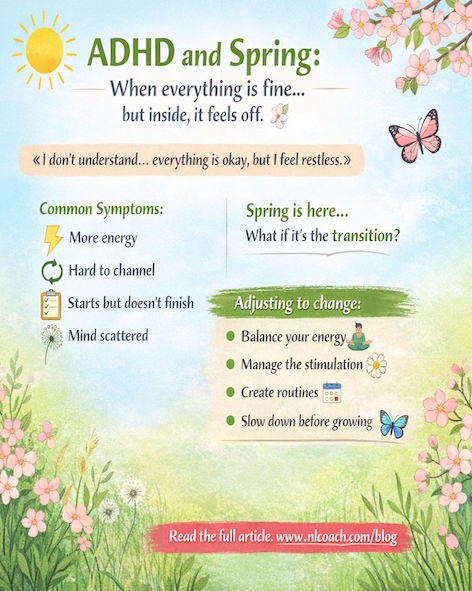
Many of my clients are currently sharing a form of restlessness: they have more energy, but it is difficult to channel; they feel a diffuse agitation and a difficulty maintaining focus. Rather than a lack of discipline, this reflects a nervous system in an adjustment phase.
These periods are not a “problem” to be fixed, but a transition to be supported. With the right self-regulation tools, it becomes possible to navigate these transitions with more fluidity and clarity.
References
- Barkley, R. A. (2015). Attention-Deficit Hyperactivity Disorder: A Handbook for Diagnosis and Treatment.
- Brown, T. E. (2013). A New Understanding of ADHD in Children and Adults.
- Castellanos, F. X., & Proal, E. (2012). Large-scale brain systems in ADHD.
- Sonuga-Barke & Castellanos, F. (2007). Spontaneous attentional fluctuations in ADHD.
- Vandewalle, G. et al. (2009). Light as a modulator of cognitive brain function.

