
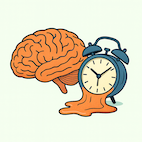
 What is “time blindness”?
Many people with ADHD experience a form of blindness to time: time exists in only two categories — “now” or “not now”. As a result, you can lose hours in something that captures your attention… or on the opposite side, flutter around without being able to anchor yourself to one task. This isn’t disrespect, and it’s not a lack of discipline. It’s neurological.
Time perception is less stable, duration estimates are less accurate, and switching from one activity to another requires a huge amount of mental energy. Stress, interest, boredom, and emotion also change how time feels as it passes.
Why does this happen?
This is not about willpower. ADHD affects several key functions:
- Planning, starting, and stopping a task take more executive effort.
- Working memory: it’s hard to keep in mind “where am I in time” without visual or audio cues.
- Motivation and dopamine: the ADHD brain reacts better to what is stimulating, concrete, and immediate than to an abstract, distant deadline.
- Emotional regulation: emotions change the relationship to time (when I’m stressed, everything becomes urgent; when I’m bored, everything becomes “later”).
In practice, it looks like this: arriving late “despite good intentions;” planning 20 minutes for something that takes 2 hours; losing track of time in an activity; pushing everything to the last minute because it’s only under pressure that time becomes “real.”
No, this is not laziness
Common myth: “They don’t respect other people’s time.”
Reality: Without adapted tools, the ADHD brain can’t feel time passing and adjust in real time. This is not a moral problem. It’s not a lack of effort. It’s not just “be more disciplined.” We’re talking about a real neurocognitive difference.
Another myth: “You just need a planner.”
Reality: A planner without a strategy to support executive functions stays theoretical. Systems need to be living, visual, auditory, repetitive — not just written down somewhere.
And ADHD medication in all this?
Important: medication can help attention, alertness, working memory. It can create better conditions to apply your strategies. But it does “not teach” time perception. Its direct impact on “time blindness” is often limited — sometimes nonexistent. Medication does not replace external anchors, alarms, and transition routines.
So, you can feel more focused… and still lose track of time if you don’t have visible/audible anchors. The real winning effect comes from the combo: medication (if prescribed) + concrete strategies + healthy transitions between tasks.
This text is for information and does not replace medical advice.
Okay… what can I do right now?
Here are simple strategies I often use with my ADHD clients. You don’t need to apply them all. Pick 1 or 2, test them for a week, adjust. 1. Make time visible ¨ Put a visual timer or countdown where you work. ¨ Use a clock in every important zone (desk, kitchen, bathroom before leaving). The goal is that “time lives outside your head, not only in your head.” 2. Work in blocks that include transitions Think in 3 parts: ¨ Before (5 minutes): I prepare what I need. ¨ During (25–45 minutes): I work on ONE thing. Soft alert 5 minutes before the end. ¨ After (5 minutes): I tidy up, I write the next mini-step, I book the next block. This ritual protects mental energy and reduces the chaos of a task that “bleeds forever.” 3. Add the “hidden time” We almost always forget the time it takes to close a task, move, land. Intentionally add a 5 to 15 minutes “buffer” before and after appointments or activity changes. This prevents cascading lateness. 4. Compare estimate vs reality Quickly write: “I think this will take 30 min.” Then note the real time. After 1–2 weeks, apply your “real factor” (often x1.5 or x2). You become more accurate without judgment, just with data. 5. Two timers for important tasks ¨ One timer that counts down to the overall deadline (the “macro”). ¨ One timer for the current action block (the “micro”). Both together keep the brain connected to present time AND future time. 6. Multiple reminders Do not rely on a single reminder. Set up a series: T-24 hours, T-2 hours, T-30 minutes, T-10 minutes… plus a reminder that says “I need to leave NOW,” not just “The meeting starts now.” Usually it’s the “time to leave” reminder that’s missing. 7. Body-doubling / coworking Working in someone’s presence (in person or silent Zoom) helps you stay in real time and makes transitions easier (“we start now,” “we stop now”). 8. The meeting with “tomorrow-you” At the end of a block, leave yourself a tiny message: ¨ Where to pick up next time? ¨ What trap to avoid? You make the future concrete, emotional, not abstract. |
When should you get support?
You might consider support if:
- Repeated lateness has consequences at work, in school, or in your finances.
- You’re carrying a lot of shame, guilt, or emotional exhaustion around time.
ADHD coaching (and psychoeducation around emotional regulation, organization, and transitions) can help you build systems that are realistic, supportive, and adapted to YOUR brain — not to an “ideal theoretical brain.”
Remember
Time blindness in ADHD is not personal negligence. It’s a difference in perception and execution, which can be supported with external cues, transition routines, and a way of planning the day that respects how your brain works. Medication can support attention, but it’s your systems that become your time GPS.

